
As electric vehicle (EV) adoption surges across Texas, having a dedicated Level 2 (240-volt) residential charging station installed in the garage has transitioned from a niche luxury to an essential household utility. However, installing a continuous high-amperage electrical load into existing residential service equipment requires careful forensic evaluation under the National Electrical Code (NEC).
1. Understanding Level 1 vs. Level 2 EV Charging Speeds
Electric vehicle charging is categorized into distinct operational tiers:
- Level 1 Charging (120-Volt AC): Plugs into a standard 120V household wall outlet. Delivering a modest 1.4 kW of power (yielding 3 to 5 miles of range per hour), a full charge on a 75 kWh battery pack can require 40 to 50 continuous hours.
- Level 2 Charging (240-Volt AC): Utilizes a dedicated 240V single-phase circuit operating between 32 and 48 amperes (7.7 kW to 11.5 kW), replenishing 25 to 40 miles of range per hour and completing a full charge overnight.
2. The NEC 125% Continuous Load Rule (NEC Article 625)
Unlike a clothes dryer or electric oven that cycles heating elements on and off over short intervals, an EV charger draws maximum rated current continuously for 6 to 10 hours. Under NEC Article 625 and NEC Section 210.20, branch circuits supplying continuous loads must be rated for at least 125% of the continuous draw:
- A 32-amp EV charger requires a minimum 40-amp circuit breaker and 8 AWG copper wire.
- A 40-amp EV charger requires a minimum 50-amp circuit breaker and 6 AWG copper wire.
- A 48-amp hardwired EV charger requires a dedicated 60-amp circuit breaker and 6 AWG or 4 AWG copper wire.
3. Performing NEC Article 220 Service Load Calculations
Many homes built across Houston between 1960 and 1985 were equipped with 100-amp or 125-amp main electrical service panels. Adding a 50-amp continuous EV load to a 100-amp panel running a central 4-ton air conditioner, electric water heater, and kitchen appliances exceeds the calculated capacity of the utility service drop, risking main breaker nuisance trips and meter socket overheating. A service "heavy-up" to 200-amp service is frequently required.
4. Residential Building Science & TREC Standards of Practice
A certified residential home inspection is a rigorous evaluation of interconnected building systems. Under the Texas Real Estate Commission (TREC) Standards of Practice (§§535.227–535.233), Secured Inspections executes a systematic forensic protocol across all major home components:
- Structural Envelope & Elevation Survey: Auditing foundation slabs, crawlspace framing, exterior masonry weep screeds, roof trusses, and attic ventilation using digital altimeters and thermal imaging to detect active movement and moisture intrusion.
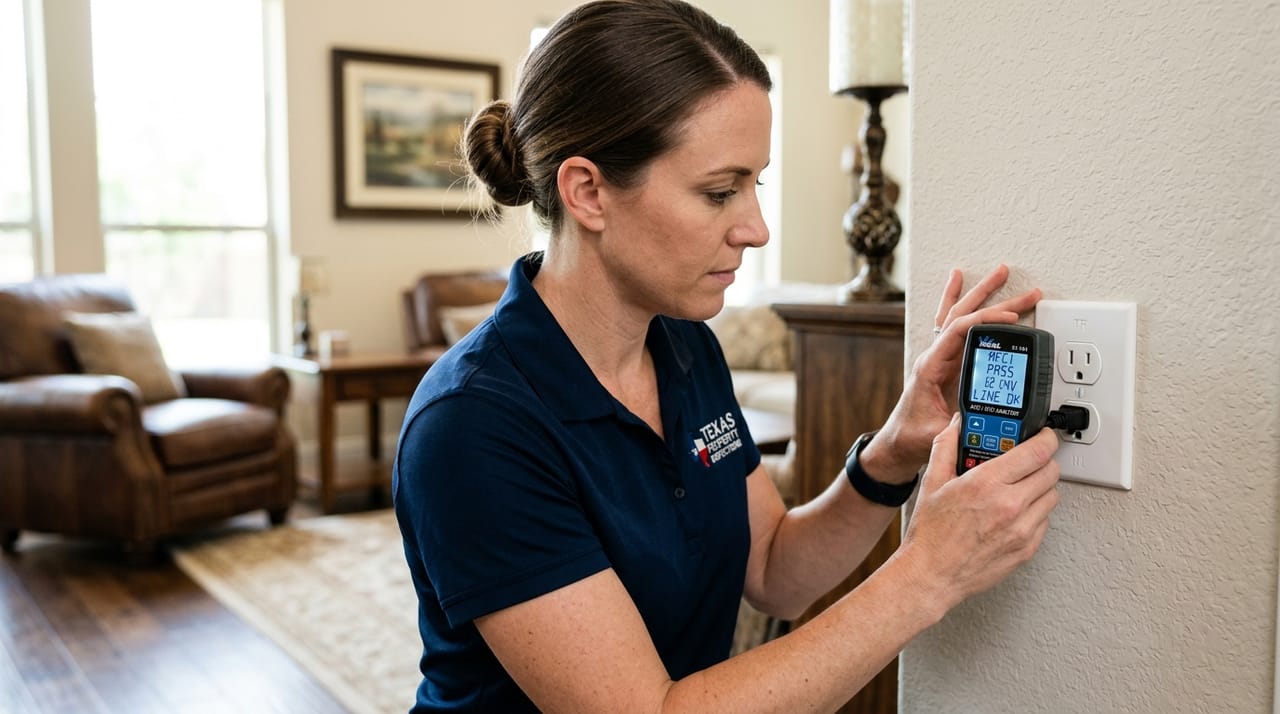
- Electrical Life-Safety Diagnostics: Verifying arc-fault circuit interrupter (AFCI) and ground-fault circuit interrupter (GFCI) trip response, main service grounding electrode bonding, panelboard temperature gradients, and branch wiring integrity.
- Mechanical HVAC & Indoor Air Quality: Testing sensible and latent cooling split differentials, condensate drainage safety float switches, combustion air supplies, gas furnace heat exchangers, and ductwork insulation R-values.
- Plumbing Supply & Drainage Pressure Testing: Checking static water pressure, thermal expansion tanks, water heater temperature-pressure relief (TPR) discharge lines, fixture flow, and waste drainage performance.
By delivering comprehensive, clear, and data-driven inspection reports, our forensic team ensures prospective Texas homeowners possess complete clarity regarding property condition before removing contractual contingencies.
Need an Objective Forensic Property Inspection?
Residential Pre-Purchase, ASTM E2018 Commercial PCAs, Termite WDI, Sewer Camera Scopes, and FLIR Thermal Infrared diagnostics across Greater Houston, Galveston, and Brazoria.
