
During any real estate transaction or property ownership cycle in Southeast Texas, understanding exact building conditions prevents catastrophic repair liabilities.
Key Forensic Protocols & Industry Standards
Property inspection standards under TREC §535 Standards of Practice and building codes (IRC / NEC / ASTM) require a systematic, non-invasive forensic evaluation of structural components, electrical panels, plumbing distribution, HVAC performance, and building envelope integrity.
- Laser Altimeter Foundation Surveys: Verifying concrete slab elevation variance to detect early soil settlement.
- FLIR® Infrared Thermography: Scanning electrical service panels and insulated ceilings for invisible high-resistance hotspots and latent moisture.
- Aerial Drone Inspections: Utilizing 4K aerial drones to safely inspect steep pitch architectural shingles and chimney flashing.
- Underground Sewer Scopes: Inserting self-leveling color cameras through cleanouts to identify root intrusion and pipe bellies.
Texas Option Period Best Practice
Always request your comprehensive inspection on Day 1 of your Option Period. This guarantees sufficient time to review digital reports, obtain contractor estimates, and negotiate closing concessions with TREC Form 39-11 (TXR 1903).
Coastal Building Science: The Battle Against Island Humidity
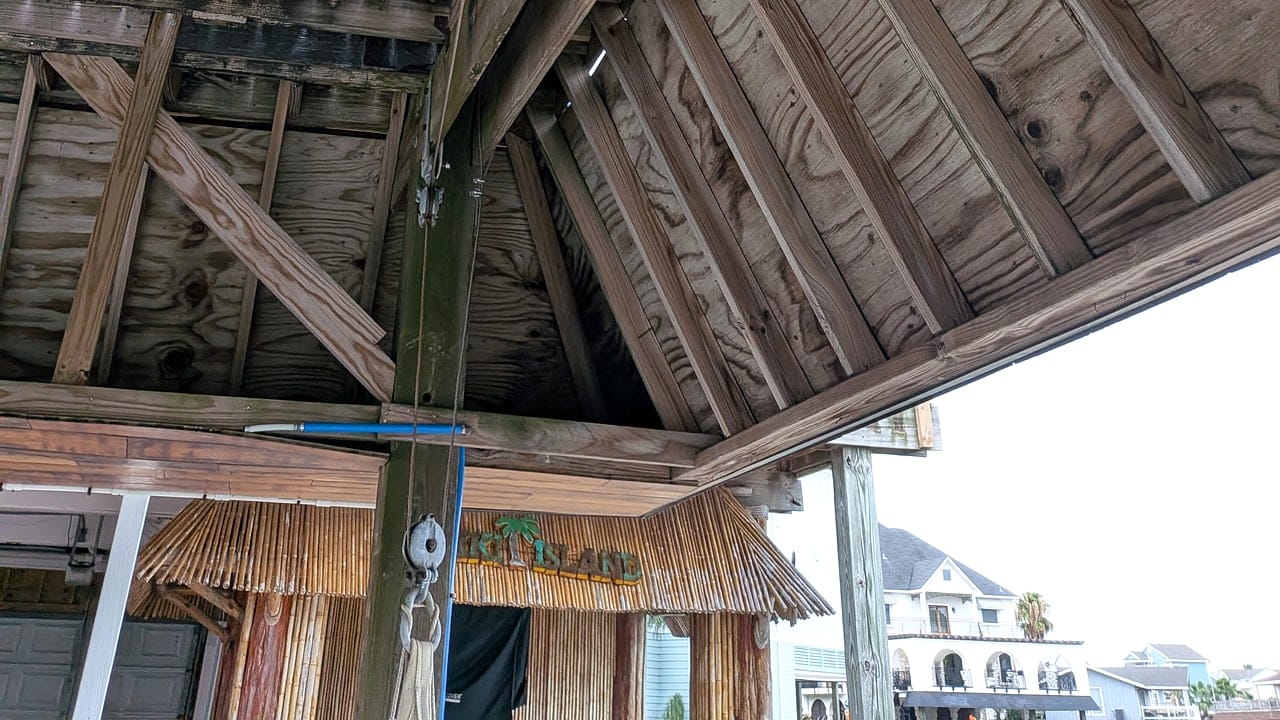
Building elevated pier-and-beam and stilt homes on Galveston Island, Bolivar Peninsula, and coastal Brazoria County presents extreme microclimatic challenges. Surrounded by the Gulf of Mexico and Galveston Bay, these structures endure year-round relative humidity frequently exceeding 90%, relentless salt fog, and periodic storm surge flooding. Managing crawlspace moisture is critical to preventing structural subfloor collapse and toxic fungal blooms.
The Fatal Flaw of Open-Cell Spray Foam & Fiberglass Batts
One of the most dangerous defects discovered in coastal crawlspaces is improper subfloor insulation:
- Fiberglass Batt Insulation Traps: Traditional fiberglass batts installed under subfloors act as giant sponges, absorbing coastal humidity and holding moisture directly against floor joists, causing rapid fungal decay and wood rot.
- Open-Cell Spray Foam Degradation: Open-cell foam absorbs moisture vapor like a sponge. Under coastal humidity, trapped vapor condenses against the wood subfloor, rotting subflooring while remaining completely hidden beneath the foam.
- The Proper Solution: Only closed-cell polyurethane spray foam (minimum 2.0 lb density) provides an impermeable vapor retarder and air barrier capable of withstanding the coastal marine environment.
Ground Vapor Retarders & Hurricane Strapping Corrosion
Ground evaporation in low-lying coastal areas constantly wicks groundwater vapor into crawlspace framing. Installing a heavy-duty, 20-mil puncture-resistant reinforced polyethylene vapor barrier completely covering the soil eliminates ground capillary wicking. Additionally, coastal inspectors must audit structural hurricane tie-downs and joist hangers for advanced galvanic corrosion caused by airborne marine chlorides, requiring 316 stainless steel or hot-dipped galvanized hardware.
FEMA NFIP Flood Vents & Hydrostatic Relief Standards
For enclosed coastal foundation crawlspaces located within FEMA Special Flood Hazard Areas (V Zones and A Zones), strict compliance with National Flood Insurance Program (NFIP) Technical Bulletin 1 is legally mandatory. Enclosed foundation stem walls must provide engineered flood vents installed on at least two exterior walls. The bottom of all flood vents must be positioned no higher than 12 inches above adjacent grade. Engineered flood vents allow rapid bi-directional water flow during tidal storm surges, equalizing hydrostatic pressures that would otherwise collapse solid concrete masonry unit (CMU) crawlspace foundation walls.
Timber Piling Decay Forensics: Dry Rot & Marine Borers
For stilt homes elevated on 8x8 or 10x10 treated timber pilings along Galveston's West End, inspectors perform direct sounding and resistance probing from grade up to the floor girder connection. The ground-line transition zone (0 to 18 inches below grade) represents the primary vulnerability zone where alternating wet-dry conditions accelerate soft-rot fungal decay and termite infestation. Verifying proper chromated copper arsenate (CCA) retention ratings (minimum 0.60 to 2.50 pcf for marine immersion) ensures the pilings maintain their axial and lateral load-bearing capacity during Category 3+ hurricane wind loads.
Need an Objective Forensic Property Inspection?
Residential Pre-Purchase, ASTM E2018 Commercial PCAs, Termite WDI, Sewer Camera Scopes, and FLIR Thermal Infrared diagnostics across Greater Houston, Galveston, and Brazoria.
